

ai

The $647,420 Nike Pickup That Looked Legitimate — Until It Wasn’t

A driver arrived at a Memphis facility with documents that appeared sufficient to collect a Dallas-bound shipment of Nike merchandise. The cargo left the dock. But the driver was not completing the authorized movement, the paperwork was fraudulent, and the shipment headed towards the Chicago area instead.

The fictitious pickup happened on 21 August 2026. Nike contacted the Cook County Sheriff’s Police Organized Retail Crime Unit two days later, and investigators ultimately recovered approximately $647,420 in merchandise at a distribution facility in Des Plaines, Illinois, together with a stolen trailer. At the time of the report, no arrests or charges had been announced and the investigation remained active.[1]

This was not a failure of a lock. It was a failure of trust: the wrong person presented documents that looked right long enough for legitimate staff to release valuable cargo.

When a document looks right but custody is wrong

Traditional shipping documents describe an intended transaction. They do not necessarily prove that the person standing at the dock is the person currently authorized to execute it.

A convincing PDF, bill of lading or pickup reference can be copied, altered or generated from compromised information. The Nike incident is especially instructive because the shipment did not first disappear from an unattended parking area. It was handed over at origin after false paperwork made an unauthorized collection appear legitimate.[1]

It also sits within a wider pattern. In a separate Nike case, federal prosecutors alleged that unauthorized UPS labels were used to divert products from the company’s Memphis distribution operation. Reporting on that case describes “ghost labels” covering original shipping labels and redirecting packages to private addresses; those allegations have not been proven in court.[2]

The common weakness is clear: when operational truth lives only in editable labels, emails and documents, whoever can reproduce the appearance of authority may be able to redirect the physical goods.

Blockchain should verify the handover, not archive the fraud

Simply uploading a document to a blockchain is not enough. If false information is accepted at the start, an immutable database only preserves a false statement.

The useful model is different: create a verifiable digital chain of custody and require every physical handover to match its current authorized state. Before a warehouse releases a shipment, the system should be able to answer five questions:

  1. Which exact shipment is being collected? A unique digital identity binds the order, cargo unit, pallet or container to the operational record.

  2. Who is authorized right now? The approved carrier, driver, vehicle and pickup window are recorded by trusted parties, rather than inferred from a document presented at the gate.

  3. Has anything changed? A destination, carrier or collection instruction cannot be silently overwritten. A new authorization becomes a visible, time-stamped event.

  4. Is this handover happening in the expected place and time? A one-time release credential can be bound to the shipment, facility and pickup window.

  5. What happened after release? Independent IoT data confirms departure, movement and route exceptions instead of relying only on status messages from the party holding the load.

In that model, a counterfeit document is no longer the authority. It is merely a claim that must match the shared, verifiable record.

What the Nike pickup could have looked like

Imagine the same collection with digitally verified custody controls.

At the Memphis gate, the operator scans the shipment identifier and the driver’s one-time pickup credential. The system checks both against the latest authorization recorded for that shipment. If the driver, carrier, vehicle, destination or collection window does not match, the cargo is not released and the discrepancy is escalated through a known channel.

If all checks pass, the handover is signed as a new custody event. A cargo-level tracker then confirms when the load leaves the facility. A Dallas-bound shipment moving towards Chicago crosses a route or geofence rule, generating an alert while intervention may still be possible.

The incident report says investigators recovered the Nike merchandise after the diversion was identified.[1] A verified release process could have moved the decisive control point earlier—from recovery after the theft to refusal at the dock. No technology can guarantee prevention, but forged paperwork becomes much less useful when it cannot satisfy the digital authorization and physical-event checks required for release.

Sensefinity connects the record to the real cargo

The hard part of supply-chain blockchain is connecting digital claims to physical events. Sensefinity addresses that gap with IoT “oracles”: trackers and sensors that collect cargo location and environmental data, register it in the Sensefinity platform and can also write selected information to a logistics blockchain. Authorized partners can access the shared record without requiring direct access to one another’s internal IT systems.[3]

Our Blockchain solution provides the tamper-evident event layer. Our NB-IoT trackers locate assets on land and at sea and can issue alerts when an asset enters or leaves a configured geofence.[4]

Together, those capabilities support a stronger release and custody process:

  • digitally signed shipment and pickup authorizations;

  • an auditable history of instruction changes;

  • verified handovers between shipper, carrier, warehouse and receiver;

  • cargo-level location evidence independent of the truck or transport paperwork;

  • immediate alerts for unauthorized departure, route deviation or unexpected arrival;

  • a provenance record that follows the goods beyond a single logistics provider.

Trust the verified event, not the convincing document

Fictitious pickup succeeds in the gap between what a document says and what the operation can prove. Closing that gap requires more than checking logos, signatures and reference numbers. It requires a shared source of truth, a controlled handover and independent evidence from the cargo itself.

The $647,420 Nike recovery had a positive outcome. The more important objective for the next shipment is to make forged paperwork fail before the doors close and the truck leaves.

Talk to Sensefinity about combining IoT visibility, geofencing and blockchain-backed chain of custody for high-value cargo.

Sources

  1. $647K Nike cargo recovered near Chicago after fraudulent Memphis pickup — FreightWaves

  2. How Nike insiders were charged in a lucrative sneaker theft conspiracy — Los Angeles Times

  3. Sensefinity Logistics Blockchain

  4. Sensefinity NB-IoT Trackers

Fewer Thefts, Twice the Losses: The $304.6 Million Visibility Gap

Cargo theft incidents fell in the second quarter of 2026. The financial damage did not.

Verisk CargoNet documented 677 supply-chain theft incidents across the United States and Canada in Q2 2026, down 26% from the same quarter a year earlier. Yet estimated losses rose from $135.7 million to $304.6 million. Among incidents with a reported commodity value, the average reached $564,009.

This is not a contradiction. It is a warning: organized groups do not need to steal more freight when they can identify and divert the right freight.

For shippers of enterprise technology, metals, pharmaceuticals, food and other high-value goods, the new risk is concentration. A single compromised shipment can now erase the benefit of dozens of successful deliveries.

The shipment has become the target

CargoNet’s analysis points to continued targeting of enterprise computer equipment, networking components, cryptocurrency-mining hardware and industrial metals. These goods often travel through conventional logistics networks even when the value inside a trailer reaches several million dollars.

That creates a dangerous mismatch: extraordinary cargo protected by ordinary visibility.

A transport-management system may confirm that a truck was assigned. A carrier portal may show that a delivery is in progress. Neither necessarily proves that the valuable pallet is still with the expected vehicle, following the authorized route or remaining under the correct custody.

The distinction matters because modern cargo theft is increasingly strategic. CargoNet reports that business-email compromise and shipment misdirection remain important access points. Criminals can use a compromised account to identify valuable loads, impersonate trusted parties and alter shipment instructions while appearing legitimate.

In that environment, tracking the journey only at dispatch and delivery leaves too much time—and too many handovers—unobserved.

From vehicle visibility to cargo visibility

The answer is not one more status call. It is an independent data layer attached to the asset that matters.

Sensefinity’s NB-IoT trackers and sensors are designed to locate assets on land and at sea, record environmental conditions and generate alerts when an asset enters or leaves a configured geofence. Depending on the use case, the monitored asset can be a container, a pallet, a crate or the cargo itself.

This changes the security model in four practical ways:

  • Independent location: the shipment can report its own position instead of relying only on the tractor, trailer or driver’s phone.

  • Geofence alerts: an unexpected departure from an authorized corridor, yard or destination can be flagged while intervention is still possible.

  • Condition monitoring: temperature and humidity thresholds help reveal whether sensitive cargo remained within specification during a diversion or delay.

  • Datalogging and auditability: a continuous history gives operations, insurers and investigators evidence of where the asset moved and under which conditions.

No single technology prevents every theft. Carrier verification, access controls, secure communications and trained people remain essential. Cargo-level IoT complements those controls by reducing the period in which a diverted shipment is invisible.

Why response time determines recovery

High-value cargo moves quickly after a successful theft. Loads may be transferred, split, relabelled or routed into established resale channels. The longer a shipper waits to discover a deviation, the less useful yesterday’s location becomes.

Real-time alerts turn detection into an operational event rather than a reconciliation problem. If an asset exits a planned geofence or fails to arrive where expected, the shipper can investigate immediately, preserve the movement history and share actionable information with security partners.

The goal is not simply to know that a loss occurred. It is to know soon enough to change the outcome.

Proof across every handover

Location answers “where?” High-risk supply chains must also answer “what happened?” and “who had custody?”

Sensefinity’s IoT data can also be registered in a logistics blockchain, creating a traceable record of location and environmental conditions such as temperature, humidity and shock. This combination links physical events to a shared digital history.

For insurers and cargo owners, that evidence can support faster incident reconstruction. For customers, it can strengthen confidence that a shipment followed the expected route and remained within agreed conditions. For regulated or sensitive goods, it helps replace assumptions with verifiable data.

The lesson behind $304.6 million

The Q2 figures show why incident counts alone can be misleading. Fewer thefts did not produce lower risk because criminals concentrated on more valuable cargo and more sophisticated methods.

Supply-chain security must respond in the same way: focus protection on the shipment, not only on the vehicle; detect deviations as they happen, not after delivery fails; and preserve evidence across every handover.

The next loss may not come from more crime. It may come from one carefully selected load moving through one avoidable blind spot.

Sensefinity turns containers, pallets and cargo into connected assets—helping companies see where their goods are, understand their condition and act when the journey no longer matches the plan.

Talk to Sensefinity about cargo-level visibility.

Sources

  • Verisk CargoNet, “Cargo Theft Losses More Than Double to $304 Million in Q2 Despite a Drop in Thefts,” 6 August 2026: https://www.globenewswire.com/news-release/2026/08/06/3340253/0/en/cargo-theft-losses-more-than-double-to-304-million-in-q2-despite-a-drop-in-thefts-driven-by-high-value-metals-and-technology-heists.html

  • Sensefinity, “NB-IoT Trackers”: https://www.sensefinity.com/nbiot-trackers

  • Sensefinity, “Blockchain”: https://www.sensefinity.com/blockchain

When the target is AI hardware: how real-time visibility stops theft and speeds recovery

By Sensefinity — August 29, 2026

Over the past few weeks, cargo theft in the United States has gained a new and extremely expensive target: artificial intelligence hardware. U.S. press reports describe thieves ramming security escorts and hijacking data-center equipment shipments in California, with the so-called "bump and run" tactic costing around $111 million in data-center freight. On another front, rail cargo theft runs at roughly $200 million a year. In Germany, thefts at highway rest areas (A7, A11) and "Planenschlitzer" — tarpaulin slashers — keep the logistics sector on alert.

The pattern is clear: as the value per pallet rises, so does the sophistication of those who steal it. A single pallet of AI accelerators or servers can be worth more than an entire truckload of conventional goods. And once diverted, the equipment disappears into the grey market within hours.

The problem isn't just theft — it's invisibility

The thief's biggest advantage is the supply chain's blindness. Between leaving the warehouse and reaching its destination, cargo passes through hands, trucks, rest areas and depots where almost no one knows exactly where it is, what temperature it is at, or whether it has been opened. When something goes wrong, the first question — "where was the cargo at 3 a.m.?" — often has no answer.

This is where Sensefinity's approach comes in.

Prevent: make theft visible before it happens

Sensefinity uses NB-IoT trackers and smart sensors together with 4G/LTE-M connectivity and AI monitoring to give continuous visibility of what is being moved — containers, pallets or high-value equipment.

  • Real-time location. A tracker fixed to the cargo or pallet reports position independently of the driver and the truck. If the cargo leaves the planned route, or stops at an unauthorized rest area, the system raises an immediate alert.

  • Opening and tamper detection. Door, shock and motion sensors detect when a container or box is opened outside an authorized stop — often before the theft is completed.

  • Geofencing and routes. The AI compares the actual route with the planned one and flags deviations, anomalous stops, or "bump and run" (where the trailer is separated from the tractor).

  • Condition as evidence. Temperature, shock and humidity are recorded continuously, building forensic proof of what happened to the cargo in transit.

The deterrent effect is simple: cargo that "sees and talks" stops being an easy target.

Recover: cut response time from days to minutes

If theft occurs, response speed decides whether the equipment is recovered or resold. Sensefinity trackers stay active even after diversion:

  • Post-theft tracking. As long as the tracker has cellular coverage (NB-IoT/LTE-M), location keeps being reported — often inside the buyer's vehicle or warehouse, not the owner's.

  • Tamper-proof history. Movement, opening and stop events form a timeline that authorities can use to reconstruct the path of the theft.

  • Response integration. Alerts can be routed to security teams or law enforcement, shrinking the time between theft and action.

In a market where AI hardware can be resold within hours, those minutes matter.

Why NB-IoT and LTE-M matter in the field

Low-power, wide-coverage technologies like NB-IoT and LTE-M are ideal for long-haul cargo: they work where ordinary phones fail (underground warehouses, rest areas, rural areas) and draw little battery, enabling weeks of monitoring without recharging. It is exactly the coverage a pallet of servers needs as it crosses a continent.

Conclusion

Theft of AI hardware is not an isolated "physical security" problem — it is an information problem. Whoever knows where the cargo is, in real time, and can prove what happened to it, holds the advantage. Sensefinity turns invisible cargo into trackable cargo, deterring theft at the source and accelerating recovery when something goes wrong.

Because in the new game of high-value logistics, to see is to protect.

Sensefinity — Internet of Cargo. AI- and Blockchain-powered supply chain visibility, from origin to destination.

Vodafone installs Sensefinity solution at the largest Portuguese maritime cargo shipping company

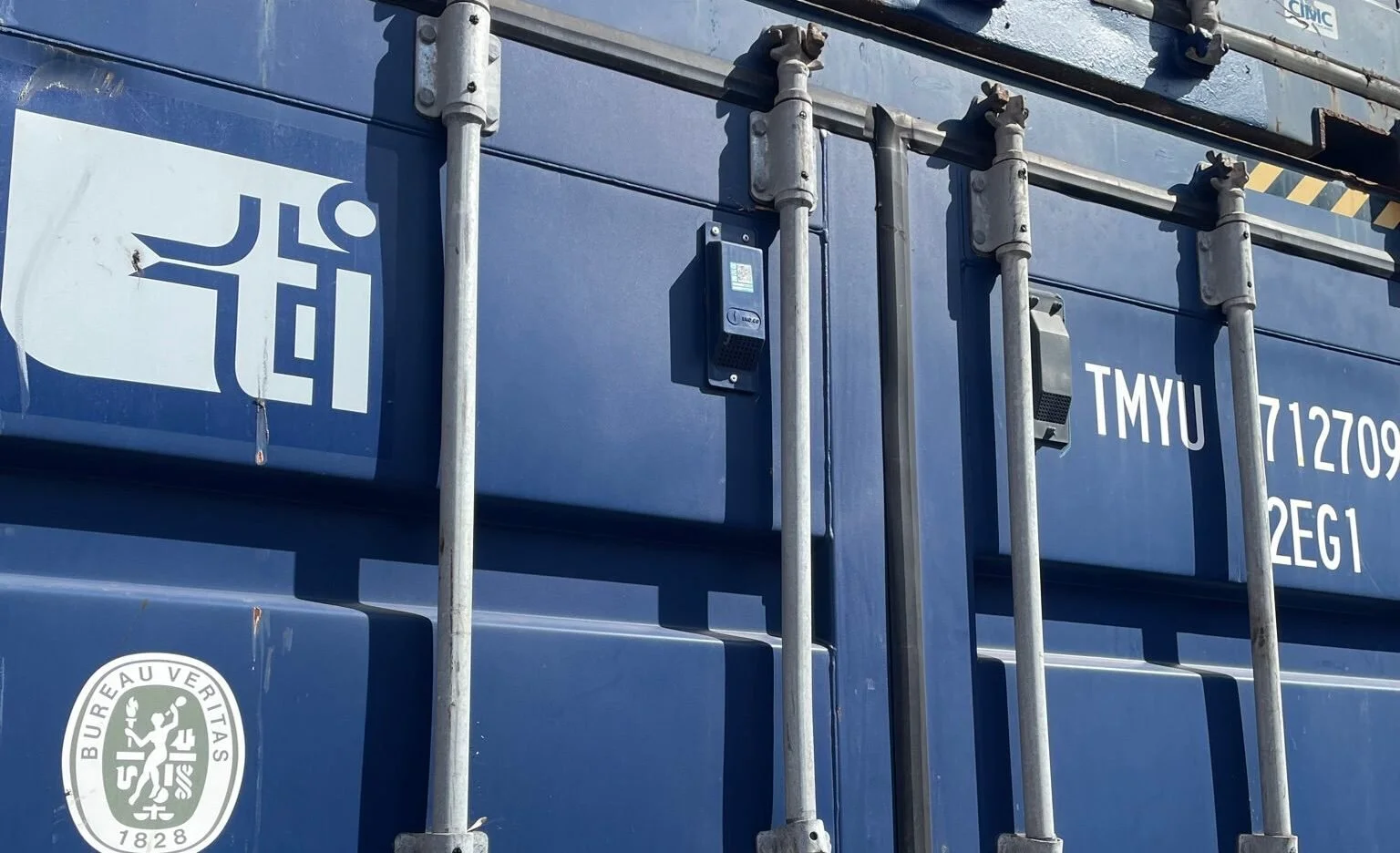
Transinsular, the largest Portuguese maritime cargo shipping company, implemented the Vodafone Smart Container solution to monitor the location and integrity of its containers. This technology was developed by Sensefinity.
The solution was installed in 90% of Transinsular's container fleet, which operates between Mainland Portugal, Azores, Madeira and Cape Verde.
Matthieu Roger, Administrator of Transinsular, explains that “this technology allows Transinsular to optimize the rotation of its containers by 20%”

Read the Executive Digest report.